Manufacturers cut manual inspection cost by moving routine visual checks to cameras and a trained detection model running on an NVIDIA Jetson at the line, with inspectors kept for exceptions. BytezTech builds these manufacturing visual inspection systems: proof of concept on your own parts in 4 to 8 weeks, then edge deployment and alerts through n8n.
Key takeaways
- Direct labour is only part of the cost: defect escapes, rework, scrap and fatigue related misses add up.
- A custom model trained on your parts and lighting beats generic tools; few shot methods handle new variants.
- Edge inference on NVIDIA Jetson keeps images on site and gives sub 100 ms decisions at line speed.
- AI agents turn a detection into an action: stop the line, alert a supervisor, log to MES or ERP.
- Start with one line and one defect family, measure, then scale.
Manual quality inspection remains one of the biggest cost drains in manufacturing today. With rising labor expenses, human fatigue, inconsistent results, and expensive defect escapes, many plants spend hundreds of thousands sometimes millions annually on inspection alone. In 2026, forward-thinking manufacturers are cutting manual inspection costs sharply by deploying custom computer vision systems powered by AI Agents.
At BytezTech, as an NVIDIA Inception member and n8n Community Creator, we help manufacturers and IT consultancies implement these intelligent solutions. This article explains exactly how custom computer vision combined with AI Agents delivers dramatic cost savings, real-world ROI, and a competitive edge.
The True Cost of Manual Inspection in Manufacturing
Manual inspection carries far higher costs than most realize. Direct labor is only the beginning.
A typical QC inspector’s fully loaded annual cost ranges from $50,000 to $90,000 depending on location and shifts. For a medium-sized plant running multiple lines with 4-6 inspectors per shift, this easily exceeds $400,000-$700,000 per year. Add hidden costs such as:
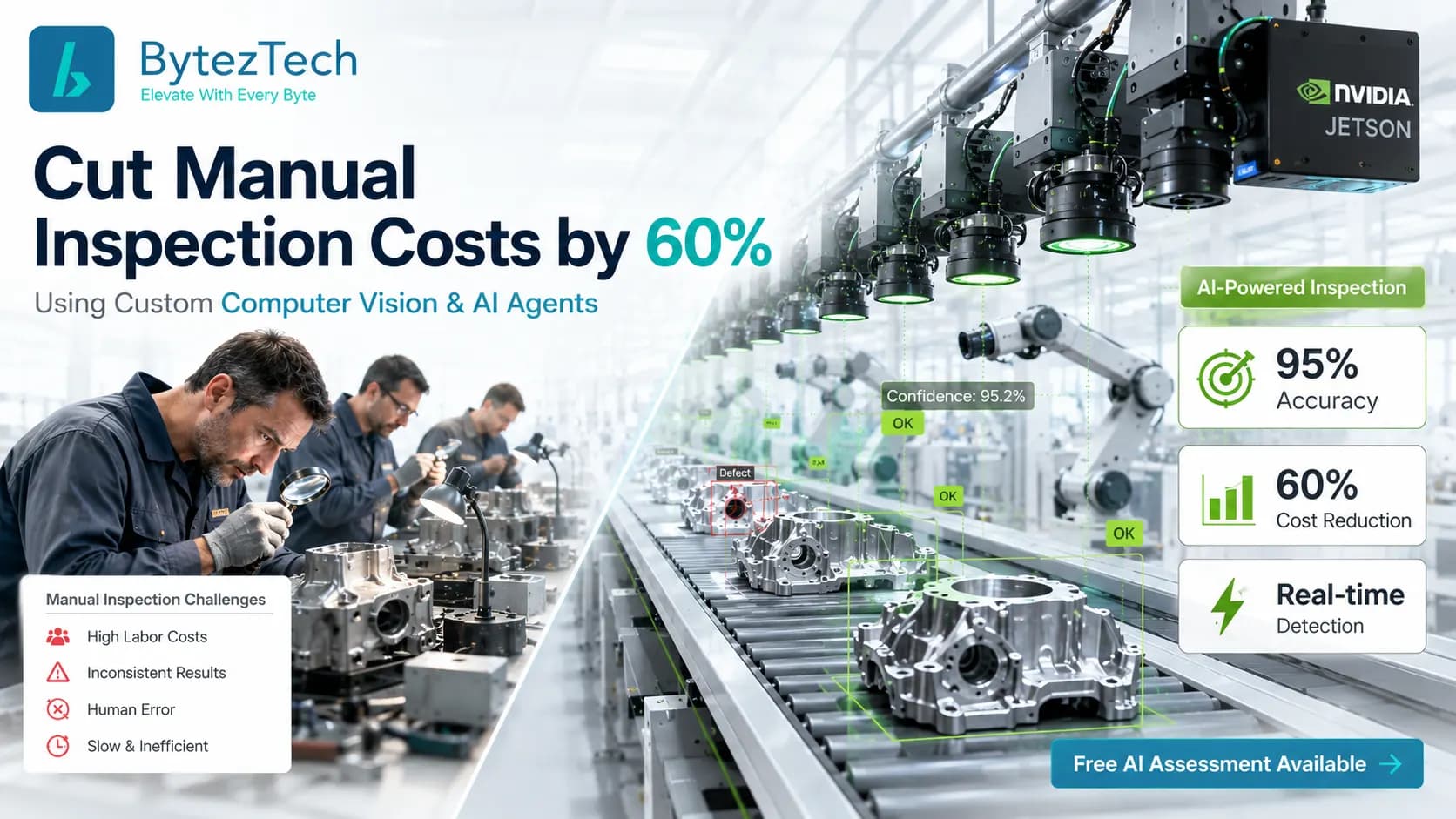
Defect escapes: Missed defects lead to rework, scrap, warranty claims, and lost reputation. Industry data shows manual accuracy often hovers between 80-85%, dropping further during night shifts or high-volume periods.
Fatigue and inconsistency: Human performance declines over time, creating quality variability.
Throughput bottlenecks: Slow manual checks limit production speed.
Training and turnover: Constantly onboarding new inspectors adds expense.
Studies reveal that manufacturers can spend 15-25% of production costs on quality-related issues, with manual inspection forming a large chunk. In high-volume sectors like automotive, electronics, metals, and pharmaceuticals, these costs directly erode margins.
How Custom Computer Vision and AI Agents Reduce Inspection Costs
Custom computer vision systems use high-resolution cameras, edge AI hardware, and deep learning models to inspect products in real time. When combined with intelligent AI Agents, the system doesn’t just detect defects - it understands context, triggers actions, and continuously improves.
Here’s how the cost reduction happens:
Labor optimization: Automating 70-90% of routine visual checks reduces the need for manual inspectors. Many implementations achieve 40-60% overall labor cost savings in quality departments.
Higher accuracy: AI systems routinely reach 95-99% detection rates, cutting defect escapes dramatically.
24/7 operation: Systems run at full production speed without breaks or fatigue.
Reduced scrap and rework: Early detection prevents bad parts from moving downstream.
Faster throughput: Removing inspection bottlenecks can increase line output by 30-50%.
NVIDIA-powered technology makes this possible at the edge. NVIDIA Jetson devices (Orin series) deliver powerful onboard inference with low power consumption, ideal for factory floors. Combined with NVIDIA TAO Toolkit for model training and DeepStream for video pipelines, these solutions process thousands of parts per hour with sub-100ms latency.
Key Applications That Drive Savings
Surface Defect Detection: Identifying scratches, cracks, dents, discolorations, or welding issues on metal, plastic, or painted parts. AI excels at subtle variations that humans miss.
Assembly Verification: Confirming correct component placement, orientation, torque marks, or missing parts in complex assemblies.
Dimensional & Measurement Inspection: High-precision checks using 2D/3D vision for tolerance compliance.
Packaging & Labeling Inspection: Ensuring correct labels, print quality, and seal integrity.
Safety & Surveillance Integration: The same infrastructure supports worker PPE detection and hazard monitoring.
AI agents elevate these applications. Built with frameworks like NVIDIA Metropolis, these agents can:
- Reason about root causes (e.g., “This scratch pattern suggests machine misalignment”).
- Trigger automated workflows via n8n (stop line, alert supervisor, log to MES/ERP).
- Send instant notifications through AI-powered WhatsApp bots.
- Learn continuously from new data.
Real-World ROI and Case Studies
The results are compelling:
- A steel manufacturer improved accuracy from ~70% to 98%, achieving $2 million+ annual savings and a staggering 1900% ROI in the first year.
- Automotive implementations (similar to BMW) report 37% defect reduction, 22% OEE improvement, and hundreds of thousands in annual savings per line.
- Electronics manufacturers have reduced defect escape rates from 2.3% to 0.1%, saving $1.8 million yearly in warranty claims.
- Average benchmarks show $600K - $700K labor savings per line, plus major reductions in scrap and rework. Payback periods typically range from 6-12 months, with 200-400% three-year ROI common.
For Indian and global manufacturers facing competitive pressure, these gains translate into better margins, higher export compliance, and stronger positioning in global supply chains.
BytezTech’s Proven Implementation Approach
We follow a low-risk, high-reward methodology tailored for manufacturers and IT consultancies:
- Free AI Assessment: We evaluate your current inspection pain points, lines, and potential ROI at no cost.
- Rapid Proof of Concept (4-8 weeks): Deploy a pilot using your actual products and environment.
- Custom Development: Train models with NVIDIA TAO on your data (including synthetic data for rare defects).
- Edge Deployment: Install on NVIDIA Jetson hardware for secure, low-latency performance.
- AI Agent & Automation Integration: Connect with n8n workflows and WhatsApp bots for intelligent alerting.
- Continuous Optimization: Monitor performance and retrain models as products or processes evolve.
Our solutions emphasize data security, minimal disruption, and seamless integration with existing PLCs, MES, and ERP systems.
Potential Challenges and How to Overcome Them
- Initial investment: While higher upfront than manual methods, ROI arrives quickly.
- Change management: We include operator training and phased rollout.
- Variability in products: Modern few-shot and self-supervised learning handle new variants efficiently.
The Path Forward for Manufacturers in 2026
Cutting manual inspection costs significantly is achievable - not with generic tools, but with custom computer vision and AI Agents designed for your specific operations.
The manufacturers who act now will enjoy lower costs, superior quality, and greater agility as competition intensifies.
Ready to slash your inspection costs?
BytezTech offers a Free AI Assessment for qualified manufacturers and IT consultancies. Our team will analyze your lines, estimate potential savings, and outline a clear roadmap.
Contact us today to schedule your no-obligation assessment. Let’s build intelligent inspection systems that deliver measurable ROI and position your operations for long-term success in the AI-driven manufacturing era.

Written by
Chintan PoriyaFounder & CEO, BytezTech
Chintan brings over 11 years of proven experience in technology leadership, AI product development and digital transformation. As the founder of BytezTech, he has built the company from a three-person team into a dedicated AI solutions company delivering GPU-accelerated computer vision, intelligent automation and AI agent systems to clients across 8 countries.